
Only a few of my friends know where the Faroe Islands are located. But after reading this report, you will too be in the know. This eighteen-island chain is located midway between Iceland and northern Scotland in the North Atlantic. Travelers can reach the Faroes via Iceland as we did; or through a few northern European hubs. The best connected European-Faroe hub is Copenhagen. Not surprising since the Faroe Islands is a self-governing territory of Denmark.
Micky and I also know where these islands are located because we visited them last month. The Faroe’s North Atlantic weather was not the draw: late summer daily high temperatures were around 55 degrees and lows were 53…often cloudy with an occasional sprinkle. A light waterproof windbreaker came in very handy. The draw was remoteness, topography, culture, and certainly the puffins.
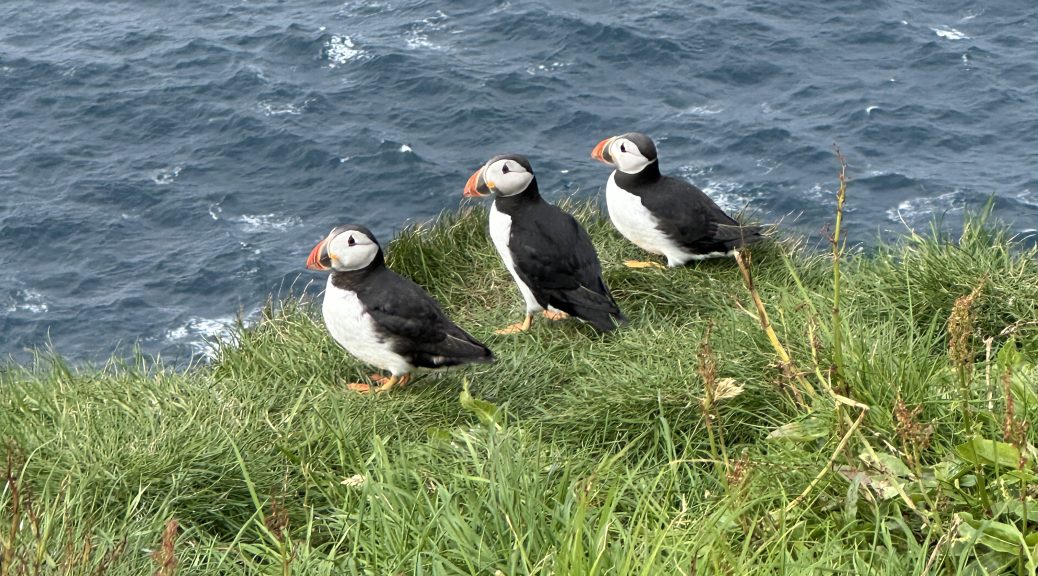
Most of the Faroese puffins live on the western island of Mykines. At least they live there from late spring until early fall – – about four months. Then, for eight months, they live on the ocean. Right on the ocean, bobbing up and down, flying a bit, and diving for fish. In late spring they return to Mykines where they nest in three-feet deep burrows. The females hatch one egg annually. The newly hatched chick will emerge from its burrow in late summer and fly out to the ocean where it will live, not for eight months, but for three straight years before it returns to land and begin its mature life: fishing, procreating, and then returning to the sea for eight months each year thereafter. Life span: about 40 years – – unless it gets eaten sooner by the Great Skua, a predatory sea bird.
After Puffins mate for the first time, they will return to the same partner annually for the remainder of their 40 years. Just how they find their mate upon returning from the sea each year is a mystery to me. After all, they look completely alike.
We reached Mykines and the puffins by ferry and once on the island we were required to engage a local guide. Our home-from-college female guide was one of just fourteen summer inhabitants of the island. These summer residents service the puffin-tourism trade and look after the sheep. In winter, when the island is reached only by helicopter, the population drops to six hearty souls. (You had better get along with your neighbors.) Our guide led us up a very long, steep hill to the puffin colony. We crested a small rise and spotted three of the cutest puffins imaginable. All of us visitors began jostling for position to snap photos of the three birds. I probably shot (the equivalent of) six rolls of film. Then we crested the next rise only to see a colony of a few hundred puffins. Oh well, I’m just glad our cameras no longer use film.
On Mykines we met a young (at least younger than we were) German traveler. Knowing that we had parked our rental car at the ferry port, he asked if we would be willing to drop him off at his hostel. I responded with a “thumbs up.” He replied seriously, “So, you would prefer that I hitchhike back.” Language confusion is not limited to spoken words. Please note: we kindly dropped him off at his lodging. While chatting he told us about an upcoming annual Sailors’ Day/Fish Festival. The festival was held in Klaksvik, the second largest town in the territory. Second largest with a population of 5,000. We wandered the festival grounds along Klaksvik’s harbor sampling the free fish and chips, smoked mackerel, Faroe salmon, and whale meat. The latter was dark and chewy and, we are pretty sure, not from an endangered whale species. We also boarded old sailing ships and modern boats that service the many salmon farms in the islands.
Travel among the six central islands of the chain was easy. They are connected by underwater tunnels. The locals even brag about having the only underwater roundabout in the world. Sort of cool, but after all, it’s just a traffic circle. And there isn’t much traffic. All 18 islands are home to just 56,000 people; nearly half (23,000) live in the capital, Torshaven. And for you linguists, Torshavn is Faroese for Thor’s Harbor – – appropriately named after the Norse god by the Faroese, who have descended from Viking stock. For the record, Faroe means sheep in the local language and that language is similar to Icelandic. Worth noting, in addition to Viking (Norse) DNA, the Faroese also carry Celtic (Scottish) genes.
The Faroe Islands are an incredibly clean land: no litter lying about. There are next to zero smokers, I think the strong winds blow out the matches. There are next to no flying insects, I think the insects don’t like the strong winds. There are also no trees. Cool summers, grazing sheep, and strong winds with salt spray are the inhibitors. Recall that above I mentioned the benefit of a windbreaker. Keep that in mind when you visit. Surprisingly, the lack of trees offers spectacular views of grass-covered mountains, fjords, vertiginous cliffs, turf-roofed homes and plunging waterfalls.
Not a beach vacation, but if you cherish remoteness, nature, and puffins you will love it.
Can’t wait to see the pics!
My thought is that the puffins probably think all humans look completely alike.
I’m really glad they can always fund their mate. But how do we (via biologists, I suppose) know this? Anyway, if it’s really true, I’m happy for them, because 40 years would be a long time to be sleeping around.
Maybe they fish and bob and look out for Great Skuas together for the 8 off-island months of the year?